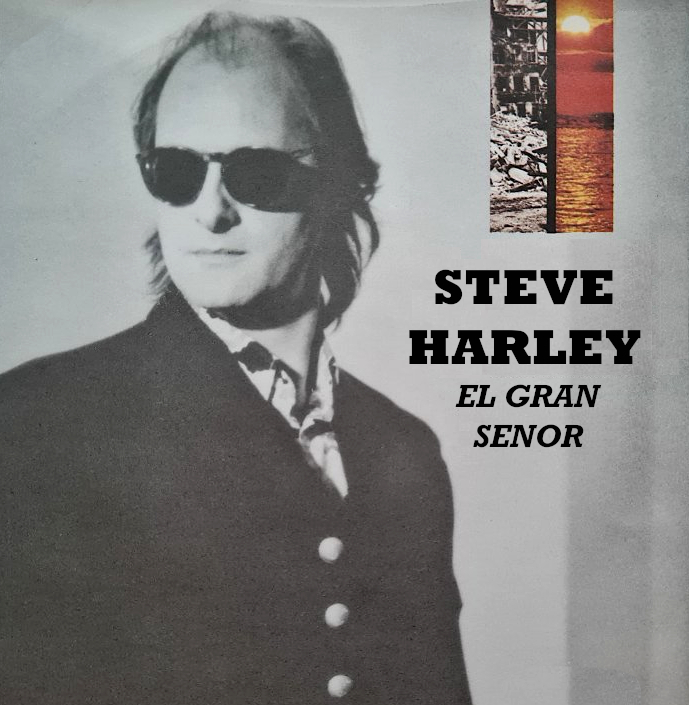
El Gran Senor is an unreleased solo studio album by Steve Harley, recorded between 1985 and 1986. It was intended for release in 1986, then later 1987, through RAK Records. Although the album was shelved, two tracks were later included on Harley’s third solo album, Yes You Can, in 1992, and four were re-recorded for the same release.
Background
After his success with Cockney Rebel in the 1970s, Harley was less active in the music industry during the 1980s. He released the occasional single, some of which became minor hits, and performed live on a limited basis only. One of these performances was Steve Harley & Cockney Rebel’s show at the Camden Palace in London on 14 December 1984, which was filmed for TV broadcast and a VHS release. In 1985, Harley produced a demo tape from the concert footage, highlighting six of the newer songs from the set, in the attempt to generate record company interest and gain a new recording contract. He subsequently signed a three-album recording contract with Mickie Most’s RAK Records and began recording material for a new solo album at RAK Studios in London. He told the Eastern Evening News in 1985, “It is the first time for five years that I have cared about the music business. My years in the business were good years and it was a terrific job to have. In 1981, I got married and now have a three-year-old son. The months and years just seemed to pass by. Then I woke up and realised that I had done nothing and felt quite ashamed. I am not naturally lazy, but for a time I lost the hunger.” Harley said it was Most who really encouraged him to “get back to work”.
Harley’s debut single for RAK was “Irresistible“, which was released in May 1985 and reached number 81 in the UK charts. It was followed by “Heartbeat Like Thunder” in April 1986 (UK peak: 172) and a remixed version of “Irresistible” in June 1986 (UK peak: 156). The latter single noted on the back sleeve that the song was “from the forthcoming album El Gran Senor“, which was named after the racehorse of the same name. Earlier working titles for the album included The Big Heat and Moveable Feast.
Harley was “halfway through [recording] the record” in 1985 when he became involved with Andrew Lloyd Webber’s upcoming Phantom of the Opera musical. Mike Batt recommended him as the “rock singer” that Webber was looking for to duet with his wife Sarah Brightman on the title track. The subsequent recording was released as a single in January 1986 as a means of promoting the upcoming musical and “test[ing] the water” in terms of public reception. It reached number 7 in the UK charts, giving Harley his first top 40 chart action in 10 years. Harley told the Evening Times in 1986, “It was ironic, I’d been doing nothing for three or four years, then suddenly I was working on two [projects] at the same time!” Harley then successfully auditioned for the role of the Phantom in the musical itself, but he was later dropped and replaced by Michael Crawford before the show ran.
After he was dropped from the musical, Harley continued working on his solo album throughout 1986. In May 1986, he announced in the Daily Mirror that he was planning “my first British tour for some time [to] start in September to promote the album”. He later revealed it was going to be a 20-date tour. Hoping that the release of the remixed “Irresistible” in July 1986 would “firmly re-establish [him] on the music scene”, the single’s commercial failure stalled Harley’s comeback plans. The tour never went beyond the planning stage and the album’s anticipated September 1986 release date was pushed back until 1987.
Harley then starred as the 16th-century playwright Christopher Marlowe in the rock musical Marlowe in London in September 1986. Speaking to The Guardian in August 1986, Harley revealed that he intended to finished off some vocal tracks and carry out a final mixing of the album once the Marlowe musical was finished. It was still expected that El Gran Senor would be released in 1987, but the album ended up being shelved when RAK folded and was sold to EMI, which also left Harley once again without a record deal. Harley would not release an album until Yes You Can in 1992. It included two songs recorded during the El Gran Senor sessions (the 1986 extended remix of “Irresistible” and “Rain in Venice”) and four re-recordings of tracks originally recorded for El Gran Senor (“Star for a Week (Dino)“, “Promises”, “New-Fashioned Way” and “The Lighthouse”).
In a 1986 interview with Club International, Harley summarised El Gran Senor: “Some of it’s pure me. There’s ‘Star for a Week’, and a mega-piece called ‘The Lighthouse’, which is ultra-modern. There’s a lot of emulators and strange sounds. They’re off the wall and weird, a bit like a lot of people expect me to be. There’s a few tracks on the album that could almost have come from Psychomodo, only it’s today, ten years on. Yet they’re equally strange in their approach to the medium of rock. I like that. Some of it’s a bit safer, but then I’m 35 now and you write about the life you lead. Safe, maybe, but I hope they’re never middle-of-the-road.” He also told the Belfast Telegraph in 1986, “The songs are more mature, better than my old work. I want them to reflect that I’ve grown up.”
Harley later recounted that he enjoyed working with Mickie Most during the mid-1980s period, but he was critical of the synthesiser-dominated sound of the time. Speaking to Classic Rock in 2023, Harley was asked for the “worst record” he had made, to which he replied, “In the Eighties I made several tracks that were going to be on an album called El Gran Senor, and I allowed a couple of keyboard players to go rampant – in those days it was all multi-synthesisers, polyphonic. [A couple of] tracks ended up on album called Yes You Can. I heard one or two lately, because fans have been asking for us to include these titles live, so I’m listening to them at home and thinking: ‘God, that’s a bloody racket’.”
Contributors
Contributors to the album included former Cockney Rebel keyboardist Duncan Mackay, keyboardists Ian Nice (Harley’s younger brother) and Adrian Lee, Cockney Rebel guitarist Rick Driscoll, ex-Cockney Rebel guitarist Jim Cregan, guitarists Mick Ronson, Harvey Hinsley and Robin Le Mesurier, Cockney Rebel violinist Barry Wickens, Fairport Convention drummer Dave Mattacks, and Big Country drummer Mark Brzezicki. Contributions were also made by Rod Stewart (which Harley called a “rare privilege” as “Rod won’t usually sing on other people’s albums”), Midge Ure and Andrew Gold.
Tracks
No finalised track listing has been made publicly available, but the following tracks (listed in alphabetical order) were recorded during the RAK period:
- “Heartbeat Like Thunder” (Harley, Duncan Mackay) (released as a single in 1986)
- “Irresistible” (Harley) (released as a single in 1986 and included on Yes You Can in 1992)
- “Lucky Man” (Harley) (B-side of 1986 single “Irresistible”)
- “New Fashioned Way” (Harley, Mackay) (version remains unreleased, re-recorded for Yes You Can)
- “Oh How Happy” (Edwin Starr) (unreleased)
- “Promises” (Harley) (version remains unreleased, re-recorded for Yes You Can)
- “Rain in Venice” (Harley, Robin Le Mesurier) (later included on Yes You Can)
- “Sophistication” (Harley) (later released as a bonus track on Anytime: A Live Recording in 2004)
- “Star for a Week (Dino)” (Harley) (version remains unreleased, re-recorded for Yes You Can)
- “Such Is Life” (Harley) (B-side of 1985 single “Irresistible”)
- “The Lighthouse” (Harley) (version remains unreleased, re-recorded for Yes You Can)
- “Warm My Cold Heart” (Harley) (B-side of 1986 single “Heartbeat Like Thunder”)
The original El Gran Senor recordings of “Star for a Week (Dino)”, “New-Fashioned Way”, “Oh How Happy”, “Promises” and “The Lighthouse” have never been officially released, but have been in circulation for years within the fan community.
- “Star for a Week (Dino)” – keyboardist Ian Nice recalled the following in 2025 about the original recording: “I played that pan pipe sound on my Ensoniq SQ-80. Loved that synth!”
- “New-Fashioned Way” – notably more of a mid-tempo track rather than the lengthier, slower version that was recorded for Yes You Can.
- “Oh How Happy” – a cover of the 1966 Edwin Starr-penned song, this up-tempo track features prominent keyboards and female backing vocals.
- “Promises” – features violin performing the main melody, possibly recorded by Cockney Rebel member Barry Wickens.
- “The Lighthouse” – Harley described the song in 1986 as “another nod to Virginia Woolf”, following his song “Riding the Waves (For Virginia Woolf)” from his 1978 album Hobo with a Grin. He told Club International in 1986: “[It’s] a very impure love song; very strange, all emulators and crashing 18-foot breakers against the lighthouse wall, very haunting and thunderous. It’s pure allegory. It’s a love song, but it’s pure allegory.” Keyboardist Ian Nice recalled the following in 2025 about the original recording: “That [was] me playing the very first ever solo breaks for this song [using] the bagpipe type keyboard sound, later to be replaced by a violin. One can hear how the later violin players’ solos were influenced by my original ideas.”
The artwork for El Gran Senor at the top of the article is not official but my own mock-up based on the back sleeve of the “Irresistible” (1986) single.
